This post is one I wrote in 2022 for a company-wide blog in order to share some insecurities with my individual contributors. Over the last few years, I have gone back to this one any time I’ve moved into a new job or felt myself questioning my ability to be in my roles, and it has become one of my favorite pieces
That feeling I get
Anxiety. Apprehension. Self-doubt. All the hallmarks of being out of my depth with no way to right the ship. When I got my first director role, I looked at my CTO and the engineers who were assigned to my team and thought, “There is no way I’m good enough an engineer or leader to be put in charge of this thing and I’m going to get exposed and fired.” I remember that feeling viscerally, and how desperately I wanted to hide it.
Most of us have encountered a subject in our careers where we felt in over our heads, or that we were never going to understand it. We’ve felt the dread that people around us are about to realize what we already know: we don’t belong here.
This is a debilitating feeling, and a good number of us already know to call it impostor syndrome. I’d like to take some time to go over this phenomenon in order to help us start to recognize it, and to create the permission structures for ourselves and the people we work with to actually talk about it.
What is Impostor Syndrome
“The psychological experience of believing that one's accomplishments came about not through genuine ability, but as a result of having been lucky, having worked harder than others, or having manipulated other people's impressions, has been labeled the impostor phenomenon₁”
The term impostor phenomenon was first coined in 1978 by Pauline Clance and Suzanne Imes in a paper for Psychotherapy journal discussing the “internal experience of intellectual phoniness…among a select sample of high achieving women”₂ and the early family dynamics and societal sex-role stereotyping that seemed to contribute to those feelings. Today, this is more often referred to as impostor syndrome and is somewhat ubiquitous in the technology industry when explaining feelings of inadequacy in our work.
Impostor syndrome is a reinforcing self-assessment fallacy that is generally associated with feelings of inadequacy, anxiety and depression. Because we keep telling ourselves that our successes were not of our own making, each new success is just evidence for that story rather than against it.
Recognizing Impostor Syndrome
The first step in solving problems is always identifying and accepting the problem as existing. In order to do that, we need to understand how impostor syndrome manifests. Common symptoms of impostor syndrome are depression, anxiety, guilt or shame about our accomplishments, fear of not living up to expectations, overworking to obtain perfection, or self-sabotaging before attempting new things, among others.
These behaviors and feelings can manifest in many ways, but what seems to be a common example in our field is overestimating our peers’ knowledge because they may know something that we don’t. I really like this example as a teaching point, because it can be such an easy trap to fall into, and the ladder out is even simpler.
Say you are working on a project and you encounter a situation that needs a specific solution, but you haven’t yet built that type of solution. You ask a counterpart and they tell you immediately to solve it a certain way, and maybe even point you in the direction of materials explaining how. You try to pick up the solution, but it turns out to be much harder for you than you expected. Struggling against this problem, you start to feel that maybe you’re not smart enough to be there, or that everyone else seems to understand something that you don’t and that it must be your lack of ability that is the root cause. We can start thinking that the realm of all knowledge is similar to the image below.
You will often be correct that you don’t know how to do a thing. It is important to remember that not knowing is not the distortion. The distortion comes after that. It is in deciding that not knowing means you don't belong.
That picture is wrong, and it is one of the main ways we convince ourselves that what we have done was luck or accident. I believe we can overcome this kind of thinking together if we can recognize the symptoms of impostor syndrome, trace them to a cause, and harness those symptoms as a sign of growth.
Another manifestation of impostor syndrome is belief that the results justify the effort, or that bad results indicate failure or wasted effort. We then apply this failure to ourselves, as if the result would have been different had we ourselves not been deficient in some way. This version of impostor syndrome requires us to rethink how we view “failure” before we can find positive change where we may have previously only seen missteps.
Shifting our thinking
In the first example, we believed that everyone else knew more than us, and that we were in a knowledge deficit. The gap was real, but the picture we drew about it was not. We drew our knowledge as a smaller circle inside our coworker’s larger one.
If we turn that around, we should be able to see that our coworker has their own list of things they would have to ask us about. That they haven’t is more likely chance than ability. Impostor syndrome makes us count all of their knowledge and discount all of ours. Nobody’s circle sits inside anyone else’s. Our knowledge boundaries overlap, and the non-overlapping parts run in both directions.
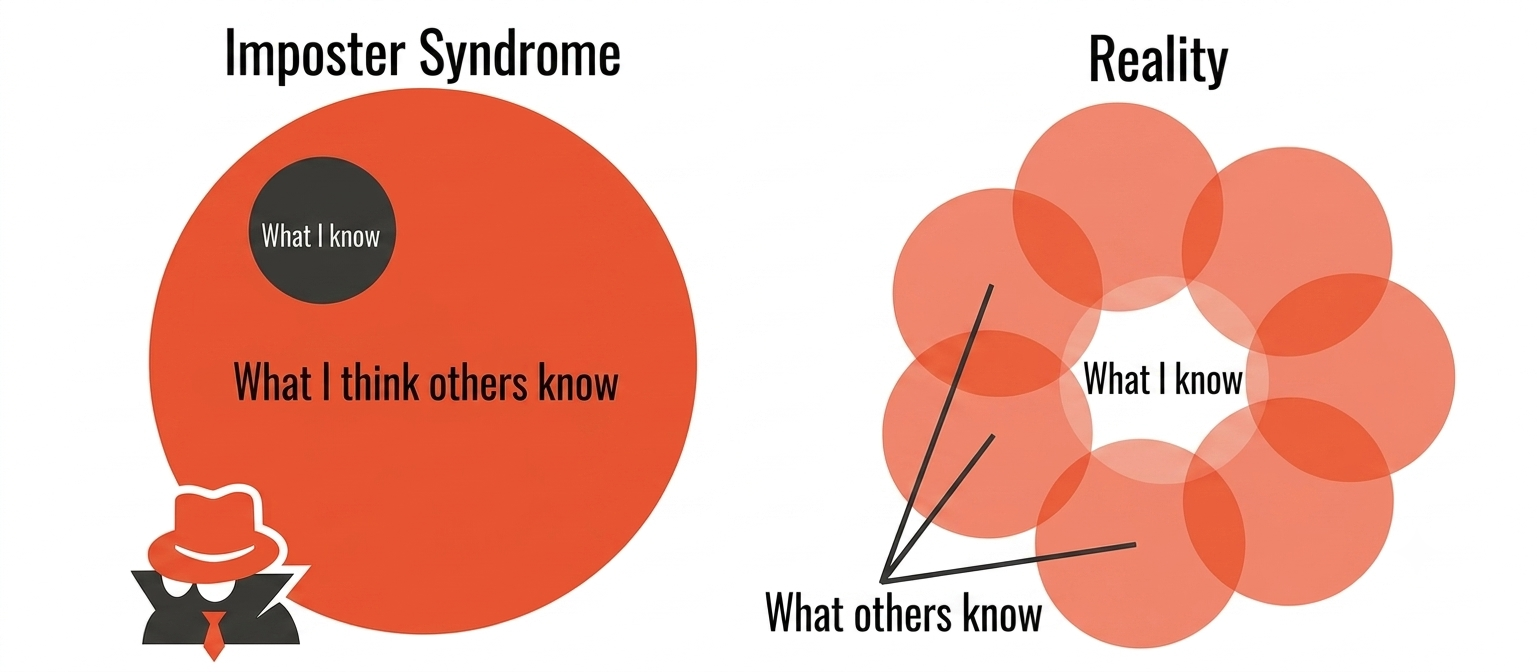
Image concept by David Whittaker (@rundavidrun). This version adapted with a new color scheme.
In rethinking the second example, we discounted most everything but the outcome as a measure of ourselves. But what if we decided that the outcomes didn’t pass judgment on our value? That the real key was everything but the results? If we can take a moment to look at everything before the result as an experiment, and consider that the effort and the things we learn along the way are the actual benefit then we can start to reorient ourselves to a mindset of failure as growth. Imagine a scientist giving up on a cure for some disease because the first experiment didn’t work. What if I asked you to now imagine yourself as a scientist of what you do, and your work an experiment? How would that change the way you think about the everyday results of your work?
Growth is not a straight line from A to B in anything we do. When we learned to walk we fell down quite a bit. We got up and kept going. We still fall down or trip as adults–sometimes embarrassingly so (but that is OK!). Professional growth is the same. A week or a quarter at a time, it looks jagged. Some months are mostly dips, and volatile enough to be alarming. Stretch the same line across a few years and it climbs, because the dips are where we learned the most. When falling means an opportunity to get up and walk better next time, we can stop seeing our falls as failures, and start to see them as part of the process of growth and as the biggest opportunities for our development.
Neither picture was accurate. No one person holds all the knowledge that we need. Once we can see that, we can start to break impostor syndrome down into its useful parts.
Harnessing Impostor Syndrome
I carried that feeling around for a few weeks. At an in-person company gathering, I finally told my CTO that working with him and with engineers that good was giving me impostor syndrome. He didn't argue the point with me. He told me I would not be in the job if he hadn't believed I could do it, and that the team was there to wrap their arms around me if it ever looked like I was faltering.
Nothing about my abilities changed in that conversation. What changed is that my assessment of them was no longer the only one I had. In a very short time he gave me evidence to change the view I had of myself, and created a safe place for me to fail.
That is why I feel it is important to write this down. If you are feeling this, you should know that the person who is leading you has felt this, too. Saying it out loud is a normal way to handle these feelings and not an admission of anything wrong. If you are the person someone brings these feelings to, your job is to do what my CTO did. Don’t argue with the feeling, and make it clear your people are not there by accident. Remember, too, that “You’re doing great” is not an answer to “I’ve never built one of these.”
I believe that impostor syndrome is a sign of growth. Look at when it shows up: not in the work you have done a hundred times, but in the first week of a new role, the first time someone hands you a system you have never seen, the first time the room is more senior than the last room. The feeling tracks how new the thing is, not how bad you are at it.
None of that makes it pleasant. It does mean you have found the edge of what you've done before, and that there is more here to learn. Naming the feeling doesn't fix it, but it does help keep it from becoming a spiral.
In thinking about how to harness impostor syndrome, I’ve broken the process down into a few general steps:
Recognize the Symptoms: Training ourselves to be in tune with our emotions and to identify the ones that we are feeling, when we feel them, helps us better identify the cause of an issue. Just creating simple goals similar to Recognize that I’m frustrated at the time I’m frustrated or Make a note when I feel inadequate at my job can help us make unconscious feelings conscious and can train our brains to recognize a problem as it arises and not after the fact.
Diagnose the cause: Learning to change “I am feeling inadequate right now.” into “I am feeling inadequate right now. Why is that?” or “I am feeling inadequate right now because of X” helps us identify the cause of our feelings and attack the source of our frustrations. Sometimes the answer is “I have never done this before.” That doesn’t need reframing, it just needs a plan. Other times you may find that you have done a thing more than once and still feel like a fraud. This is impostor syndrome, not a gap, and talking about it will help more than any amount of studying.
Externalize it: Talk to someone. Your friends, mentors, and managers are here for this, and they have likely felt the same or been through similar situations as you are now. If nothing else, an unburdening and a second opinion can help get your brain unstuck.
Accept the challenge: Name what you are actually trying to learn, and set goals for yourself to track the progress toward that goal. Accept that growth requires failure, and that improvement is seldom a linear or short path.
Repeat: You will almost certainly have these feelings again, either in the failure part of growth, or in another area altogether. Work to make this a conscious part of your day so that you can make change faster.
We all get to a point where we think, "Maybe I'm the dumb one?" (I do all the time) but the more we are able to recognize that feeling, internalize why we are feeling it, and externalize it to our teammates, the easier it becomes to say, "This is new and I might need some time or help." The better we are at these things, the better we become at breaking the negative spirals of impostor syndrome and creating positive cycles of growth for ourselves.
₁ The Impostor Phenomenon, Langford and Clance, Psychotherapy vol 30, Fall 1993 https://paulineroseclance.com/pdf/-Langford.pdf₂ The Impostor Phenomenon in High Achieving Women, Clance and Imes, Psychotherapy vol 15, Fall 1978 https://mpowir.org/wp-content/uploads/2010/02/Download-IP-in-High-Achieving-Women.pdf